





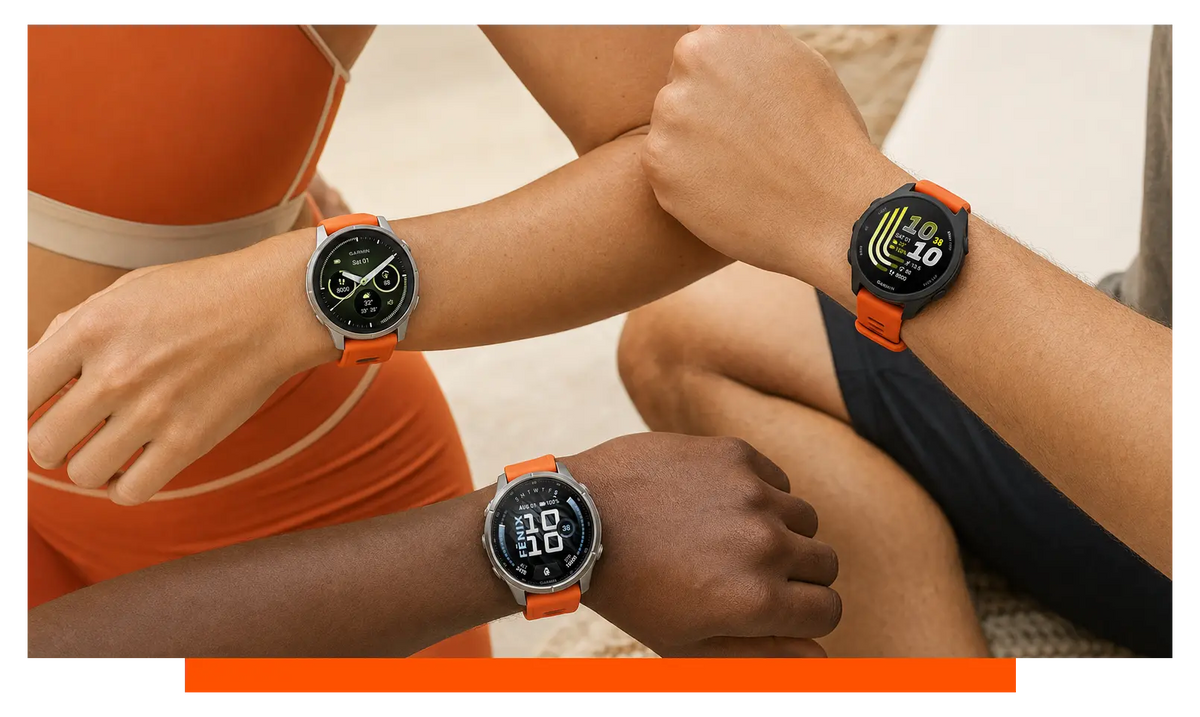
Garmin Venu 4 is the best Garmin watch for most fitness buyers because it balances gym training, health tracking and everyday wear. Choose the Garmin Forerunner 170 instead if structured running is your priority, or the Garmin Fenix 9 if long outdoor sessions and navigation matter more than all-day comfort.
Best Garmin fitness watches at a glance
Garmin Venu 4 offers the strongest balance for mixed fitness, while the other watches earn their places through more focused running, outdoor or value-led strengths.
Device prices shown below were read at the time of writing.
| Garmin watch | Best for | Training guidance | GPS workout battery | GPS accuracy | Built-in mapping | Compatible strap materials | Price |
|---|---|---|---|---|---|---|---|
| Fenix 9 | Outdoor multisport | Stamina tracking | Up to 18 hours / 30 hours / 54 hours | Multi-band GPS | Yes | Silicone, nylon, leather, milanese, metal | £859.99 / £859.99 / £949.99 |
| Venu 4 | Health and fitness | Training readiness | Up to 15 hours / 20 hours | Multi-band GPS | No | Silicone, nylon, leather, milanese, metal | £469.99 / £469.99 |
| Vivoactive 6 | Casual fitness | Garmin Coach | Up to 21 hours | All-Systems GNSS | No | Silicone, nylon, leather, milanese, metal | £269.99 |
| Forerunner 170 | Running | Training readiness | Up to 20 hours | All-Systems GNSS | No | Silicone, nylon, leather, milanese, metal | £259.99 |
| Epix Pro Gen 2 | Outdoor adventure | Training readiness | Up to 28 hours / 42 hours / 82 hours | Multi-band GPS | Yes | Silicone, nylon, leather, milanese, metal | £829.99 |
The deciding issue is not which watch has the longest feature list. It is whether you want an all-day fitness watch that remains comfortable in bed, or a specialist training and outdoor tool worn mainly for workouts.
What makes a good Garmin watch for fitness?
A good Garmin fitness watch matches its training guidance, GPS performance and physical fit to the activities you actually do each week.
Training guidance you will use
Activity recording tells you what happened; useful guidance helps you decide what to do next. Recovery time and training readiness matter when you train several times a week, because they put recent exercise, rest and general condition into context.
That depth is less important if you mainly want to log walks, gym sessions and sleep. In that situation, straightforward workout recording and coaching can be easier to live with than a screen full of performance data.
GPS battery and accuracy
GPS workout battery matters during recorded outdoor activity, not ordinary desk time. A longer figure becomes useful for hikes, long rides and extended training days; it changes much less for a short run followed by a nightly charge.
Multi-band GPS is the accuracy feature worth considering if your routes regularly pass between tall buildings or beneath dense tree cover. All-Systems GNSS remains suitable for open roads and parks, so the more advanced mode is not automatically the better use of your budget.
Comfort, case size and strap fit
A lighter, smaller case is less noticeable when you sleep and tends to sit more securely on a narrow wrist. A larger case provides room for more screen and battery capacity, but it also occupies more wrist space during presses, kettlebell work and sleeves-down commuting.
The strap changes the experience too. Silicone and nylon are practical for sweaty sessions because they cope well with regular rinsing and drying. Leather, milanese and metal give the same watch a smarter everyday look, but are better saved for lower-sweat wear.
Maps and navigation
Built-in maps are worthwhile when the watch needs to help you follow unfamiliar trails without relying on a phone. They add much less to gym work, walking familiar routes or running a known loop.
Basic return guidance can still be useful without full mapping. The important distinction is whether you merely want a recorded route or need the watch to act as a navigation tool while you move.
Best for outdoor multisport - 1. Garmin Fenix 9

Garmin Fenix 9 is the best choice here when outdoor training, navigation and rugged construction matter as much as gym tracking.
Its routable maps and multi-band GPS are the practical advantages. You can follow unfamiliar routes from the wrist, while the more accurate positioning mode helps tracks remain consistent around trees and difficult terrain. Stamina tracking also suits long sessions where pacing your remaining effort matters.
- Activity battery: up to 18 hours in the 43mm case, 30 hours in the 47mm case and 54 hours in the 51mm case
- Construction: titanium bezel and sapphire lens
- Storage: 64 GB
- Water rating: 10 ATM
- Navigation: routable maps
Fit needs thought. The 43mm case takes 20mm straps, the 47mm case uses 22mm straps and the 51mm version requires 26mm straps. That progression is useful because it lets you match both case presence and band width to your wrist rather than choosing on battery alone.
For the middle case, Garmin Fenix 9 - 47mm straps are available in silicone, nylon, leather, milanese and metal. A washable silicone or nylon option makes most sense for wet and sweaty training.
At the time of writing, Garmin Fenix 9 costs £859.99 in 43mm, £859.99 in 47mm and £949.99 in 51mm. It suits you if hiking and long outdoor sessions justify that premium; it is more watch than most gym-and-walking buyers need.
Best for health and fitness - 2. Garmin Venu 4

Garmin Venu 4 is the best fitness watch for most people because it connects gym work, recovery, sleep and everyday health without becoming an outdoor specialist.
It is particularly persuasive if you lift, walk and want to improve your general fitness. Training readiness, recovery time and workout benefit guidance provide a deeper view than basic activity totals, while the ECG app broadens its health-tracking role.
- GPS workout battery: up to 15 hours in 41mm and 20 hours in 45mm
- Smartwatch battery: up to 12 days
- GPS: multi-band GPS
- Construction: stainless steel
- Water rating: swim, 5 ATM
Compared with Vivoactive 6, the reason to spend more is guidance. Both cover strength sessions, walking and sleep insights, but Venu 4 is better equipped to help you judge recovery and understand the benefit of a workout. Choose Vivoactive 6 if logging those activities is enough.
Case size affects both battery and band fit. The 41mm Venu 4 uses quick-release 18mm bands, while the 45mm model takes quick-release 22mm bands. The smaller combination is easier to forget about overnight; the larger one gives you longer GPS recording and more wrist presence.
Both Garmin Venu 4 - 41mm straps and Garmin Venu 4 - 45mm straps include silicone, nylon, leather, milanese and metal choices. That range makes the Venu particularly easy to adapt: silicone for training, nylon for light all-day comfort, then leather or metal for work.
Garmin Venu 4 costs £469.99 in 41mm and £469.99 in 45mm at the time of writing. It is worth choosing over Vivoactive 6 when you will use its deeper recovery and training guidance rather than simply admiring it in the menu.
Best for casual fitness - 3. Garmin Vivoactive 6

Garmin Vivoactive 6 is the best-value fit for everyday activity, gym logging and sleep insights when advanced recovery guidance is not the priority.
Garmin Coach gives it useful structure, while strength tracking covers regular lifting sessions. Its 36 g case is also a tangible comfort advantage for sleep and all-day wear. At 42.2 x 42.2 x 10.9 mm, it stays relatively unobtrusive without making the AMOLED display difficult to glance at.
- GPS workout battery: up to 21 hours
- Smartwatch battery: up to 11 days
- GPS: All-Systems GNSS
- Construction: anodized aluminium
- Navigation: Back to Start
It lacks multi-band GPS and built-in maps, but neither is a deciding loss for open park walks, familiar runs or indoor training. Back to Start offers a modest navigation safety net without turning the watch into a trail computer.
Vivoactive 6 uses quick-release 20mm bands. The selection of Garmin Vivoactive 6 straps spans silicone, nylon, leather, milanese and metal, so you can keep a washable band for lifting and use a smarter one away from the gym.
At £269.99 at the time of writing, Vivoactive 6 is the sensible choice if you want the core fitness experience and do not need Venu 4's more detailed training and recovery view.
Best for runners - 4. Garmin Forerunner 170
Garmin Forerunner 170 is the better buy than Venu 4 when becoming a stronger runner is the main reason you want a watch.
Its running-focused tools include training readiness, training status, wrist-based running power, running dynamics, interval training and race guidance. That combination helps you plan and interpret training rather than merely record pace and distance. Strength, sleep and everyday health tracking remain available around your runs.
- GPS workout battery: up to 20 hours
- Smartwatch battery: up to 10 days
- GPS: All-Systems GNSS
- Case weight: 41 g
- Dimensions: 42.6 x 42.6 x 11.9 mm
It does not have multi-band GPS, so frequent running between tall buildings or under dense trees is the condition that may push you back towards Venu 4 or up to Fenix 9. On open routes, that difference is less likely to decide your training.
The fibre-reinforced polymer case keeps the design sport-focused, and its quick-release 20mm fitting gives you plenty of scope to change the feel. Garmin Forerunner 170 straps are available in silicone, nylon, leather, milanese and metal; silicone and nylon are the natural training choices.
Garmin Forerunner 170 costs £259.99 at the time of writing. It is the focused pick for training plans and race progress, not the automatic choice for someone whose week is split evenly between lifting, walking and general health tracking.
Best outdoor alternative - 5. Garmin Epix Pro Gen 2
Garmin Epix Pro Gen 2 remains an attractive outdoor alternative if its long activity battery, AMOLED display and TopoActive maps match your priorities.
This is the older option in the shortlist rather than the default current-generation recommendation. Even so, its multi-band GPS, training readiness and mapping still form a capable package for long hikes and mixed outdoor training.
- Activity battery: up to 28 hours in 42mm, 42 hours in 47mm and 82 hours in 51mm with wrist gesture enabled
- Smartwatch battery: up to 16 days
- Storage: 32 GB
- Water rating: 10 ATM
- Navigation: TopoActive maps
Its fitment follows the same useful size progression seen on the outdoor-focused models: 20mm straps for the 42mm case, 22mm for 47mm and 26mm for 51mm. The middle-sized Garmin Epix Pro (Gen 2) 47mm straps are available in silicone, nylon, leather, milanese and metal.
At £829.99 at the time of writing, it makes most sense when you specifically value its battery options and maps. Otherwise, Fenix 9 is the clearer outdoor choice, while Venu 4 is more proportionate for ordinary fitness.
Which Garmin fitness watch should you choose?
Choose according to the job the watch will do most often, then use case size and strap fit to settle the comfort question.
- If you lift, walk, track sleep and want deeper general fitness guidance: choose Garmin Venu 4.
- If you want straightforward gym and activity tracking at a lower price: choose Garmin Vivoactive 6.
- If running plans, race guidance and progress are your priority: choose Garmin Forerunner 170.
- If you hike, navigate and train outdoors for long periods: choose Garmin Fenix 9.
- If you specifically want the older AMOLED outdoor alternative with very long activity options: consider Garmin Epix Pro Gen 2.
- If you sleep in your watch or have a narrow wrist: favour the smaller case and a light nylon or silicone strap.
- If your workouts are sweaty: keep leather and metal for everyday wear and use a washable silicone or nylon band for training.
For most mixed-fitness buyers, Venu 4 still lands in the right place: more useful guidance than the casual option, less bulk and outdoor complexity than the adventure models. Running-first buyers should go Forerunner; navigation-first buyers should go Fenix.
Frequently asked questions
These answers cover common questions that arise after you have narrowed down the right Garmin for your training.
Is Garmin Vivoactive 6 good enough for strength training and rep tracking?
Yes, if you want to log structured strength sessions, sets, rest and reps. It begins counting after at least four reps in a set, but you should check the result for leg exercises and movements without a consistent, wide wrist motion.
Does Garmin Forerunner 170 support music without a phone?
Only Garmin Forerunner 170 Music supports phone-free listening through downloaded audio and Bluetooth headphones. The standard Forerunner 170 does not include onboard music playback.
Can a Garmin watch replace a chest strap for interval training or lifting?
Not when heart-rate accuracy is critical during high-motion intervals or lifting; a compatible chest strap is the better tool in that situation. The wrist sensor remains more convenient for everyday heart rate and sleep tracking.
Do Garmin training and health features require a subscription?
No, existing health, training and activity data features in Garmin Connect remain free. Garmin Connect+ is optional if you want its premium insights, training guidance and mapping features.


Leave a comment
All comments are moderated before being published.
This site is protected by hCaptcha and the hCaptcha Privacy Policy and Terms of Service apply.