


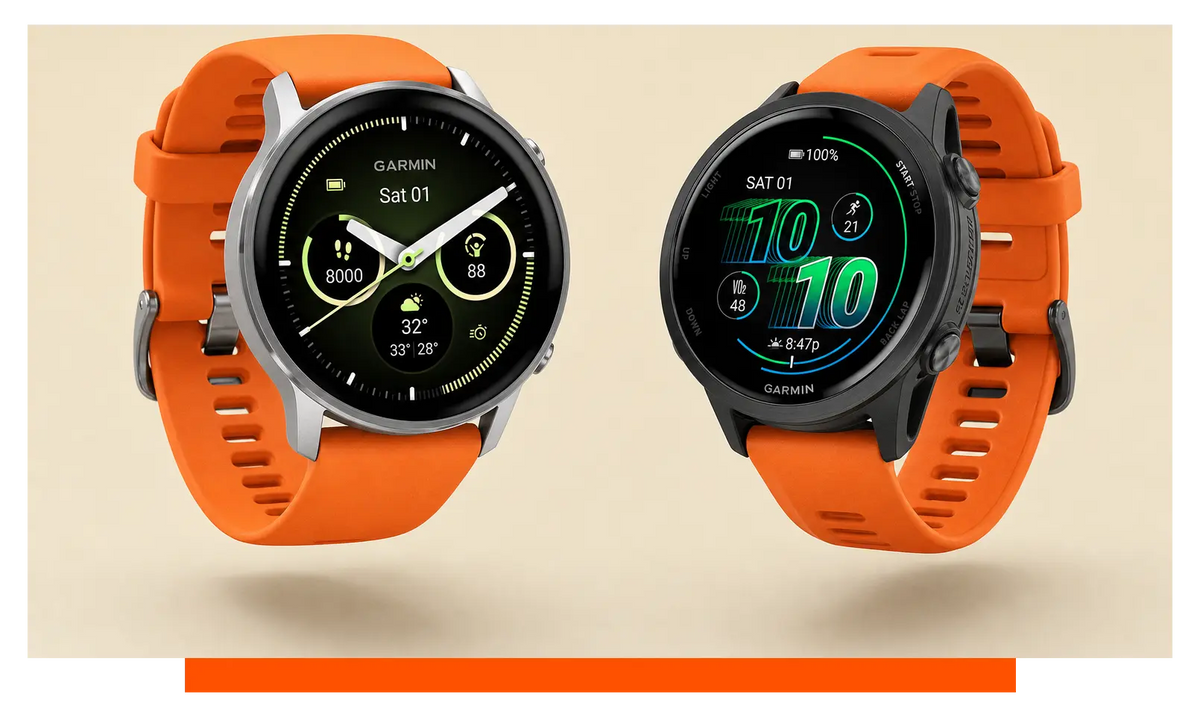
Garmin Venu 4 is the better everyday-training Garmin if you want a watch that slips comfortably into work, sleep and casual wear. Garmin Forerunner 570 is smarter for runners who rely on physical controls. The deciding factor is whether you need to operate workouts confidently with sweaty, wet or gloved hands.
On this page
- The short version
- Garmin Venu 4 vs Garmin Forerunner 570 specifications compared
- Which watch is easier to control during a workout?
- Garmin Venu 4 vs Garmin Forerunner 570: GPS battery life
- Everyday battery life
- Everyday running and training guidance
- Case comfort and wrist fit
- Strap fit and all-day comfort
- Materials and everyday appearance
- Garmin Venu 4 vs Garmin Forerunner 570: display
- GPS and water resistance
- ECG and the built-in light
- Storage and connected platform
- Price and value
- Where Garmin Venu 4 is better
- Where Garmin Forerunner 570 is better
- Who should choose which
- Frequently asked questions
The short version
- Choose Garmin Venu 4 for all-day wear: its smaller option looks less overtly sporty, while stainless-steel detailing helps it sit naturally with work clothes.
- Choose Garmin Forerunner 570 for dependable workout control: its five physical buttons are easier to use when sweat, rain or gloves make a touchscreen awkward.
- GPS battery depends on size: the larger Venu goes longest in GPS-only use, but the smaller Forerunner outlasts the smaller Venu.
- Everyday runners are well covered by either: Venu already supplies adaptive coaching, suggested workouts and useful training feedback; Forerunner adds more race-led running guidance.
- Garmin Venu 4 costs £439.99 in its smaller size and £439.99 in its larger size; Garmin Forerunner 570 costs £459.99 or £459.99, at the time of writing.
The trade that decides this comparison is simple: Venu blends into the rest of your day more easily, while Forerunner gives you surer control once a workout starts.
Garmin Venu 4 vs Garmin Forerunner 570 specifications compared
| Specification | Garmin Venu 4 | Garmin Forerunner 570 |
|---|---|---|
| Physical workout controls | 2 buttons | 5 buttons |
| GPS battery life | Up to 15 hours / Up to 20 hours | Up to 18 hours |
| Garmin ECG app | Yes | No |
| LED flashlight | Yes | No |
| Case sizes | 41 mm / 45 mm | 42 mm / 47 mm |
| Case comfort | 46 g / 56 g | 42 g / 50 g |
| Case material | Stainless steel and fibre-reinforced polymer | Fibre-reinforced polymer |
| Bezel material | Stainless steel | Aluminium |
| Everyday battery life | Up to 10 days / Up to 12 days | Up to 10 days / Up to 11 days |
| Price | £439.99 / £439.99 | £459.99 / £459.99 |
| Display size | 1.2 in / 1.4 in | 1.2 in / 1.4 in |
| Display resolution | 390 x 390 / 454 x 454 pixels | 390 x 390 / 454 x 454 pixels |
| Display type | AMOLED | AMOLED |
| Touchscreen | Yes | Yes |
| Run coaching | Adaptive Garmin Run Coach | Garmin Run Coach |
| GPS | Multi-band GPS | Multi-band GPS |
| Water rating | 5 ATM | 5 ATM |
| Storage | 8 GB | 8 GB |
| Platform | Garmin Connect | Garmin Connect |
The specifications reinforce the main choice: the two watches overlap heavily, but their different controls and case styles make them feel intended for different moments of the day.
Which watch is easier to control during a workout?
Garmin Forerunner 570 is easier to control during active workouts because its five-button layout reduces your dependence on the touchscreen. That matters whenever precise operation is more important than quickly swiping around menus.
Both watches have touchscreens, so either feels familiar when you are browsing widgets at your desk or checking health information on the sofa. Once you start running, however, the gap becomes practical. Physical buttons let you move through data screens, mark a lap or manage a session without trying to land a damp finger on the right part of the display.
Garmin Venu 4 is not difficult to operate. Its two buttons cover routine actions, and the touchscreen works well for ordinary gym sessions, walks and fair-weather runs. If you tend to start an activity and leave it recording, its simpler control layout may never bother you.
The answer changes for runners who train through winter, wear gloves or regularly adjust workouts on the move. Forerunner's extra controls provide firmer feedback and make it easier to operate by feel. You would notice the difference most during rain-soaked intervals, not while reading notifications over breakfast.
Garmin Venu 4 vs Garmin Forerunner 570: GPS battery life
Garmin Forerunner 570 has the safer GPS margin in the smaller size, while the larger Garmin Venu 4 records for longest in GPS-only mode. Your preferred case size therefore matters more than the family name.
Garmin Venu 4 reaches up to 15 hours in its smaller case and up to 20 hours in its larger case using GPS-only tracking. Garmin Forerunner 570 reaches up to 18 hours in either case size. That makes the smaller Forerunner the more reassuring option for long events, extended hikes or weekends with several recorded sessions.
With all satellite systems and multi-band positioning enabled, Garmin Venu 4 offers up to 12 hours in its smaller size or up to 17 hours in its larger size. Garmin Forerunner 570 offers up to 13 hours in the smaller case and up to 14 hours in the larger one.
Those figures are generous for normal after-work runs and typical gym visits. The more useful question is whether you prefer a smaller watch without giving up as much tracking time. In that situation, Forerunner has the edge; if you are comfortable wearing the larger Venu, Venu reverses it. On your wrist, this means fewer pre-run battery checks rather than a fundamentally different charging routine.
Everyday battery life
Everyday battery life is close enough that it should not decide the comparison by itself. Garmin Venu 4 lasts up to 10 days in the smaller case and up to 12 days in the larger one, while Garmin Forerunner 570 lasts up to 10 days or up to 11 days.
The smaller watches are level. Among the larger options, Venu holds a modest advantage, but both are built for several days of health tracking, notifications and sleep recording between charges. Frequent GPS sessions, music and display settings will have a much greater effect on your real routine than the small headline gap.
This supports Venu's all-day case without creating a decisive win. You can wear either overnight and through the working week; the main difference remains how you want the watch to feel and operate when training begins. In practice, neither should leave an everyday runner charging every evening.
Everyday running and training guidance
Garmin Venu 4 is already capable enough for non-elite everyday running, while Garmin Forerunner 570 makes more sense when your sessions revolve around structured running or race preparation. You are not stepping down to basic activity tracking by choosing Venu.
Venu provides adaptive Garmin Run Coach plans, daily suggested workouts, training readiness, training status and wrist-based running dynamics. That is a useful mix if you run several times a week, want guidance on what to do next and need recovery information without organising your day around competition.
Forerunner adds a more run-specific layer, including PacePro, projected race time, auto lap by timing gates, running power, acute load and performance condition. These features are most valuable when pacing, race targets and changing training load actively shape your sessions.
There is substantial overlap. Both suit regular running, and both can support multisport use, so a casual runner does not automatically get better training simply by choosing the model with Forerunner on the case. If you are considering other generations of Garmin's running line as well, our Garmin Forerunner 245 vs 255 vs 265 comparison explains how that range has developed.
What you would actually notice is focus: Venu presents training as part of a wider day, whereas Forerunner feels more purpose-built when a planned run is the day's main event.
Case comfort and wrist fit
Garmin Venu 4 is the stronger choice for a smaller-looking, less overtly sporty watch, although Garmin Forerunner 570 is lighter at comparable sizes. Fit is therefore a balance between visual scale and outright weight.
The smaller Venu has a 41 x 41 x 12 mm case and fits wrists measuring 110-175 mm. That compact footprint is particularly appealing if you have a narrow wrist, dislike watches extending towards its edges or want something unobtrusive enough for sleep tracking.
Venu weighs 46 g in the smaller case and 56 g in the larger one. Forerunner weighs 42 g and 50 g respectively. Its fibre-reinforced polymer construction keeps weight down, which is welcome on longer runs when repeated arm movement makes even modest differences easier to feel.
Size still changes the visual impression. Venu offers 41 mm and 45 mm cases, while Forerunner uses 42 mm and 47 mm cases. The larger Forerunner has more wrist presence and looks unmistakably like a sports watch; the smaller Venu is easier to tuck under a cuff.
For overnight comfort and discreet daily wear, the compact Venu is the more natural fit. During a long session, Forerunner's lower weight can be just as persuasive. You would feel the former through reduced bulk and the latter through reduced mass.
Strap fit and all-day comfort
Both watches use quick-release straps, but the correct width depends on the case size you choose. Checking that measurement matters because straps for the smaller cases are not universally interchangeable with the larger versions.
- Garmin Venu 4 with the 41 mm case uses 18 mm quick-release straps.
- Garmin Venu 4 with the 45 mm case uses 22 mm quick-release straps.
- Garmin Forerunner 570 with the 42 mm case uses 20 mm quick-release straps.
- Garmin Forerunner 570 with the 47 mm case uses 22 mm quick-release straps.
That fitment gives both families useful flexibility. Silicone, nylon, leather, Milanese and metal options are available for every listed case size. A breathable nylon strap can soften pressure during sleep or long days, while silicone remains practical for sweaty training. Leather, Milanese or metal changes the look for work without requiring a different watch.
You can browse Garmin Venu 4 41mm straps or Garmin Venu 4 45mm straps by case size. For the running model, use the matching Garmin Forerunner 570 42mm straps or Garmin Forerunner 570 47mm straps.
This is where Venu's everyday advantage becomes more than styling. Its compact case paired with a work-ready strap can look restrained during the day, then switch to a washable workout strap before training. Forerunner can make the same material change, but its case remains more visibly athletic. The part you notice against your skin is often the strap, not the specification sheet.
Materials and everyday appearance
Garmin Venu 4 has the more polished everyday design, while Garmin Forerunner 570 prioritises lightness and a recognisable running-watch shape. Neither approach is inherently better; it depends on whether you want your watch to blend in or signal its training purpose.
Venu combines stainless steel with fibre-reinforced polymer and uses a stainless-steel bezel. That metal detailing gives it a cleaner transition from exercise clothes to a shirt, jumper or smarter outfit. It is still a sports-capable Garmin, but it does not look exclusively intended for a starting line.
Forerunner uses a fibre-reinforced polymer case with an aluminium bezel. The result is lighter and practical, especially when your priority is keeping the watch unobtrusive during repetitive movement. Its extra buttons also contribute to a more technical appearance, though those same controls are the reason it works so well in poor conditions.
Morning to night, Venu is easier to restyle with a strap change. Forerunner looks more at home during training and makes fewer concessions to formal wear. You will see this difference every time the watch emerges from a sleeve.
Garmin Venu 4 vs Garmin Forerunner 570: display
Display size and resolution are effectively level, but Garmin Forerunner 570 has the stronger claim for outdoor readability. Garmin describes it as using its brightest AMOLED display yet, which complements the physical controls when you train outside.
Both watches offer 1.2-inch and 1.4-inch AMOLED displays according to case size. Their resolutions also match at 390 x 390 pixels for the smaller displays and 454 x 454 pixels for the larger ones. Text, maps of your data and workout fields should therefore appear similarly crisp when comparing like-sized models.
The difference is not that Venu has a poor screen. It is bright, colourful and well suited to health information, notifications and indoor use. Forerunner's outdoor emphasis simply fits its job better: clear viewing and button access are reassuring when direct light, rain or movement make interaction harder.
For ordinary use, choose the case size that is easiest to glance at without overwhelming your wrist. Mid-run, Forerunner's display-and-button combination is what you are more likely to appreciate.
GPS and water resistance
GPS capability and water resistance do not create a meaningful winner because both watches have multi-band GPS and a 5 ATM rating. Either is equipped for everyday outdoor training and swimming.
Multi-band positioning is useful around tall buildings, wooded routes and other places where satellite signals can reflect or become obstructed. It can produce cleaner tracks through difficult sections, though enabling the most demanding satellite mode also shortens battery life compared with GPS-only tracking.
The shared water rating means rain and pool sessions are part of the intended use. Forerunner's control layout still gives it the practical advantage when the watch is wet because you can rely less on the touchscreen, but that is a control difference rather than a difference in water protection.
Your recorded route should not determine the purchase on specifications alone. The wrist-level distinction appears when conditions deteriorate: Forerunner remains easier to operate without carefully touching the screen.
ECG and the built-in light
Garmin Venu 4 wins this part of the comparison because it supports the Garmin ECG app and includes a built-in LED flashlight. Garmin Forerunner 570 does not list ECG support and uses its display as a flashlight instead.
The ECG app is available only to eligible adults in supported regions with compatible software, so availability should be checked rather than assumed. Where supported, it gives Venu an extra health feature that may matter if you specifically want ECG on your wrist.
The LED flashlight is a simpler but more frequently practical difference. It can help with finding something in a dark room, navigating an unlit path or making yourself easier to spot during an evening walk. A screen-based light can still help at close range, but it is less directed.
Neither feature replaces the core reason to choose Venu, which is its suitability across work, rest and exercise. They strengthen that role. The flashlight is the difference you are likely to notice most often in ordinary life.
Storage and connected platform
Storage and the connected platform are tied, so neither should move your decision away from comfort or workout control. Both watches provide 8 GB of storage and use Garmin Connect.
The shared platform means your activity history, health trends and training information live in the same Garmin ecosystem whichever model you choose. Moving between the two does not require learning a different companion service, and both are designed to act as connected watch partners rather than entirely separate phone replacements.
Equal storage also removes another possible distraction. Your choice is not between a lifestyle watch with limited capacity and a sports watch with more room; it is between two closely related Garmin models that package their strengths differently.
Day to day, their menus may emphasise different priorities, but your records arrive in the same place. That keeps the real decision centred on how each case fits and how confidently you can control it while moving.
Price and value
Garmin Venu 4 is the better-value everyday option at the listed prices, while Garmin Forerunner 570 earns its premium mainly through its running-first controls and guidance. The right value judgement depends on whether those benefits affect every session.
At the time of writing, Garmin Venu 4 is listed at £439.99 for the 41 mm case and £439.99 for the 45 mm case. Garmin Forerunner 570 is listed at £459.99 for the 42 mm case and £459.99 for the 47 mm case.
If you mainly run for fitness, mix exercise types and want the same watch to look natural after training, Venu gives up little that you are likely to use regularly. Its ECG support, LED flashlight and more polished materials add everyday value as well.
Forerunner justifies its position when running is structured and controls are not an occasional detail. If every wet interval session reminds you why buttons matter, the extra spend serves a clear purpose. What you are paying for is confidence during training, not a wholesale improvement in every area.
Where Garmin Venu 4 is better
- Smaller-looking fit: the 41 mm case is particularly suitable for narrow wrists and overnight wear.
- More polished materials: stainless-steel case detailing and bezel make it easier to wear away from exercise.
- Longer maximum GPS figure: the 45 mm model reaches up to 20 hours in GPS-only mode.
- Everyday utility: the Garmin ECG app and built-in LED flashlight are available on Venu but not Forerunner.
- Strap versatility: quick-release fitment and work-ready materials help it shift between training and smarter settings.
Where Garmin Forerunner 570 is better
- Workout operation: five physical buttons provide more dependable control in sweat, rain or gloves.
- Smaller-case GPS endurance: the 42 mm model reaches up to 18 hours in GPS-only mode.
- Lower weight: its cases weigh 42 g and 50 g, reducing wrist load during long sessions.
- Race-led guidance: PacePro, projected race time and other run-specific tools suit structured preparation.
- Outdoor emphasis: its bright AMOLED display and button layout work together well in changing conditions.
Who should choose which
- Choose Garmin Venu 4 if you run for everyday fitness and want coaching, recovery guidance and health tracking without wearing an overtly sporty watch all day.
- Choose Garmin Venu 4 if you have a smaller wrist and care about a compact case, overnight comfort and changing to leather, Milanese or metal for work.
- Choose Garmin Venu 4 if ECG and a proper flashlight matter more than having a full set of physical workout buttons.
- Choose Garmin Forerunner 570 if you train in poor weather and need reliable control with wet, sweaty or gloved hands.
- Choose Garmin Forerunner 570 if structured running shapes your week and race pacing, load information and run-specific feedback will genuinely guide your sessions.
- Choose Garmin Forerunner 570 if low weight matters most and you prefer the purposeful appearance of a running watch.
For most everyday runners, Venu is the more adaptable wrist companion; Forerunner becomes the better answer when dependable controls are part of every serious workout.
Frequently asked questions
Can both watches store music and make or take calls from a paired phone?
Yes. Both store music for listening through Bluetooth headphones and can handle calls through their speaker and microphone when paired with a compatible phone.
Can I use either watch for triathlon training?
Yes. Both provide a Triathlon activity that records the individual segments and transitions, and both support custom multisport activities if your event format differs.
Do both work equally well with iPhone and Android phones?
Both pair with compatible iPhone and Android phones, but replying to messages or declining a call with a text response is available on compatible Android phones rather than iPhone.
Can either watch replace an Apple Watch or Galaxy Watch for notifications and payments?
Either covers smart notifications and Garmin Pay, but calls still depend on a paired compatible phone. Choose them as fitness-led phone companions rather than fully independent communication watches.
Do both watches track strength training and gym workouts?
Yes. Both can record sets and repetitions, let you edit repetitions and weight, and support structured workouts from Garmin Connect; rep counting is most reliable when each set contains a single movement.




Leave a comment
All comments are moderated before being published.
This site is protected by hCaptcha and the hCaptcha Privacy Policy and Terms of Service apply.