





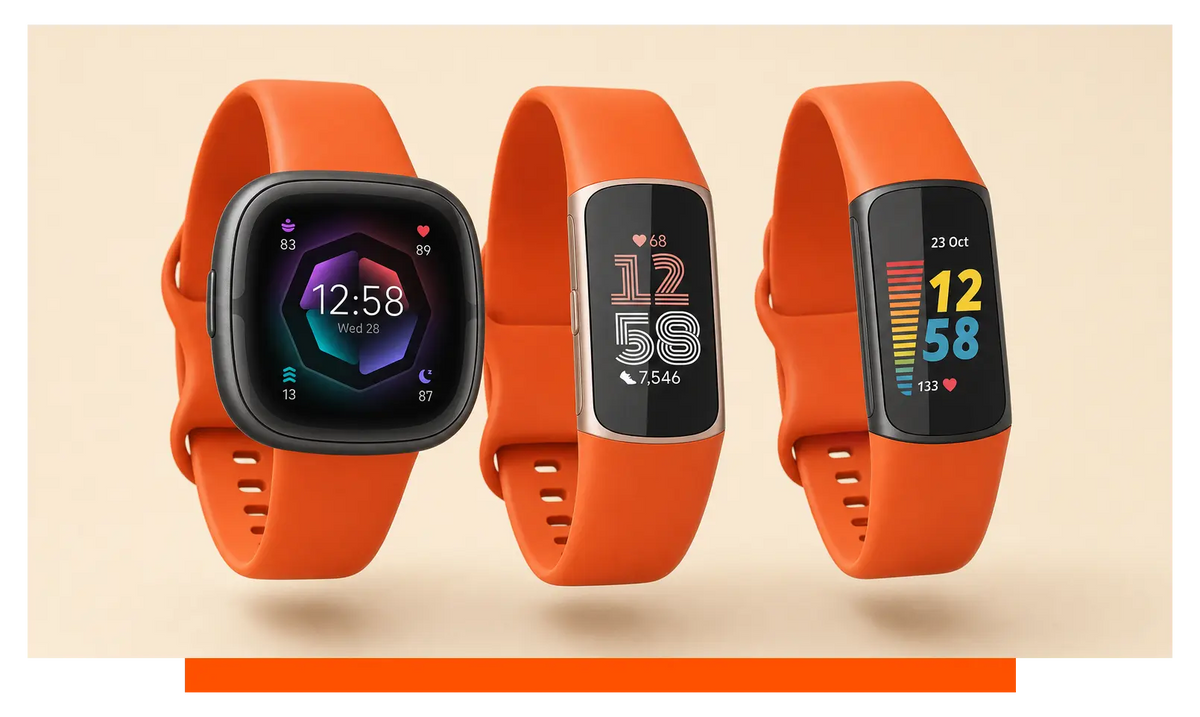
Fitbit Sense 2, Fitbit Charge 6 and Fitbit Charge 5 all track your heart rate day and night and support an on-demand ECG. The important catch is that ECG access depends on location and eligibility: it is intended for people aged 22 or over, and it cannot diagnose heart disease or provide continuous clinical monitoring.
On this page
- Fitbit heart-rate and ECG support at a glance
- What a Fitbit ECG can and cannot tell you
- Why are Fitbit heart-rate or ECG readings missing or odd?
- Who Fitbit heart data works for - and who it may let down
- Frequently asked questions
Fitbit heart-rate and ECG support at a glance
The covered Fitbit models all provide day-and-night heart-rate tracking and an on-demand ECG, with the same check duration, result categories and eligibility threshold.
| Fitbit | Heart-rate tracking | ECG | ECG duration | Minimum ECG age | ECG results | Inconclusive heart-rate range | Listed price at time of writing |
|---|---|---|---|---|---|---|---|
| Fitbit Sense 2 | Yes | Yes | 30 seconds | 22 years old | AFib, Normal Sinus Rhythm, Inconclusive | Under 50 bpm or over 120 bpm | £219 |
| Fitbit Charge 6 | Yes | Yes | 30 seconds | 22 years old | AFib, Normal Sinus Rhythm, Inconclusive | Under 50 bpm or over 120 bpm | £139 |
| Fitbit Charge 5 | Yes | Yes | 30 seconds | 22 years old | AFib, Normal Sinus Rhythm, Inconclusive | Under 50 bpm or over 120 bpm | £129.99 |
The deciding point: choose between everyday heart-rate tracking and an ECG deliberately - the former runs through daily life, while the latter is an on-demand check requiring your participation and secure skin contact.
What a Fitbit ECG can and cannot tell you
A Fitbit ECG checks the electrical signals from your heartbeat for signs of atrial fibrillation or normal sinus rhythm; it may instead return an inconclusive result.
You start the check yourself and remain still while the watch or tracker records it. A Normal Sinus Rhythm result means the recording showed the expected rhythm during that check. An AFib result means it found signs that may be consistent with atrial fibrillation, not that Fitbit has confirmed a diagnosis.
An inconclusive result does not automatically mean something is wrong. Fitbit may be unable to classify a reading when your heart rate is under 50 bpm or over 120 bpm, and movement or weak electrode contact can also prevent a usable recording.
When the answer changes
ECG support on the device does not guarantee access to the app. The feature must be available in your country or region, and you must meet its eligibility requirements. If it is unavailable where you live, these Fitbits still provide everyday heart-rate tracking, but the ECG part of the answer becomes no.
Limits that matter
A Fitbit ECG cannot diagnose the cause of palpitations, chest discomfort, dizziness or an unusual result. It also is not continuous clinical monitoring: the recording only reflects the brief period when you deliberately run the check.
Everyday heart-rate data has limits too. It can show patterns and alert you to changes, but it cannot explain why your heart rate changed or rule out a health condition. Symptoms or repeated worrying results need proper medical assessment rather than another wrist reading.
Why are Fitbit heart-rate or ECG readings missing or odd?
Missing or unusual readings usually happen because movement, moisture or poor skin contact prevents the sensors and electrodes from collecting a clean signal.
Vigorous arm movement can interrupt heart-rate tracking during exercise, especially if the tracker slides around. For ECG, moving during the check, sweat or water on the wrist, weak electrode contact and nearby electronics can all contribute to an inconclusive result.
Fit matters. Wear the device comfortably secure, around a finger’s width above your wrist bone. Too loose and it can lift or shift; too tight and maintaining comfortable, consistent contact becomes harder. You should be able to wear it through exercise and sleep without pinching.
Strap comfort can improve consistency
A replacement band cannot make ECG available or turn Fitbit data into a diagnosis, but it can make a stable fit easier to maintain. Silicone, nylon, leather, milanese and metal options are available among Fitbit Sense 2 straps, so you can choose around exercise, commuting or everyday comfort rather than tolerating a band that shifts.
The same material choices are available for Fitbit Charge 6 straps and Fitbit Charge 5 straps. Whichever material you prefer, the useful test is whether it holds the tracker steadily without needing to be pulled uncomfortably tight.
- During exercise: tighten a loose band enough to stop the tracker bouncing or rotating.
- For an ECG: dry your wrist and the device, sit still and maintain the required electrode contact.
- During sleep: use a comfortable fit that keeps the sensor against your skin without pinching.
- After an odd result: adjust the fit and repeat the check only when you are still and the device is dry.
Who Fitbit heart data works for - and who it may let down
Fitbit heart data works best for people following everyday patterns and taking occasional ECG checks, not anyone relying on a wearable for diagnosis or uninterrupted clinical surveillance.
Who it works for
- Health-trackers who want day-and-night heart-rate trends on their wrist.
- Runners and gym users who want heart-rate context during training.
- People eligible for the ECG app who want an on-demand rhythm check.
- Sleep-trackers who can maintain comfortable sensor contact overnight.
Who it is not for
- Anyone who needs a medical diagnosis or continuous clinical monitoring.
- People outside a supported ECG location or those who do not meet the eligibility rules.
- Users expecting every vigorous workout to produce an uninterrupted wrist reading.
- Anyone whose band repeatedly slides, pinches or leaves the sensor away from the skin.
Across these Fitbits, having the sensor is only the start: ECG access, realistic expectations and a comfortably secure fit decide how useful the heart data will be.
Frequently asked questions
These practical answers cover setting up, sharing and interpreting Fitbit ECG features.
How do I set up the ECG app on a Fitbit?
In the Google Health app, open Health, choose ECG under Health checks, tap Get started and follow the prompts. If ECG is not installed, open Connections, select your Fitbit, tap Apps, then choose ECG and Install.
Will Fitbit warn me automatically about an irregular rhythm?
Yes, if Irregular Rhythm Notifications are supported on your device and in your location and you enable them. Fitbit checks pulse data while you are still or asleep and may notify you after multiple readings show signs of an irregular rhythm, but this is not a real-time alert.
Is a Fitbit ECG the same as an ECG at a doctor’s surgery?
No. Fitbit ECG is similar to a single-lead ECG and distinguishes possible AFib from normal sinus rhythm, while a doctor’s 12-lead ECG records electrical information from 12 angles and can assess more heart conditions.
Do I need Fitbit Premium to use ECG?
No. ECG is available as a health check without Fitbit Premium, provided your Fitbit is compatible and you meet the location and eligibility requirements.
Can I export a Fitbit ECG result for my doctor?
Yes. In the Google Health app, open Health, select ECG, choose the relevant result, then tap Export PDF for your provider and Download PDF.


Leave a comment
All comments are moderated before being published.
This site is protected by hCaptcha and the hCaptcha Privacy Policy and Terms of Service apply.